Research

The evidence, and the gaps in it.

Most of recovery happens in a kitchen, a hallway and a bathroom, long after the clinic has said goodbye. That is where we build, so this is the page where we set out what the published research actually establishes about recovery at home, and what it does not settle yet.

We are a company. We have an obvious interest in the first column. So the second column is longer than a brochure would make it, and we would rather you read that one first.

795,000strokes a year in the United States.
Comparabledaily-living outcomes between home-based and center-based stroke rehabilitation, in a 2025 systematic review and meta-analysis (Physical Therapy, PMID 40167208).

Stroke incidence: Centers for Disease Control and Prevention. Home-based versus center-based outcomes: Physical Therapy, 2025, PMID 40167208, cited in full below.

What the evidence supports, and what remains an open question.

Four areas of published neurorehabilitation research that bear directly on what we build. Described in general terms, hedged on purpose. Specific citations are being added as each area is reviewed.

Home neurorehabilitation: four areas of published research, read across. The left column states what the literature broadly supports. The right column states what it does not yet settle.
Area of research What the literature broadly supports What is still an open question
Dose and intensity in stroke rehabilitation Broadly supported Across trials and systematic reviews, more time spent in active, task-specific practice tends to be associated with better motor outcomes, and repetition counts observed in ordinary therapy sessions are often well below those used in the studies that show benefit. The direction of the finding is consistent. The size of it varies a great deal between studies. Lohse, Lang & Boyd, Is more better? Using meta-data to explore dose-response relationships in stroke rehabilitation, Stroke, 2014. PMC4071164 Open question How much practice is enough, for whom, and in which window after stroke. Whether additional dose delivered unsupervised at home produces the same benefit as supervised dose inside a trial. Whether there is a point at which more practice stops helping, and how that point differs by severity.
Adherence to unsupervised home exercise programs Broadly supported Adherence to home programs handed over on paper generally falls over the weeks that follow discharge. Self-reported adherence is typically higher than adherence measured by any objective means. Studies repeatedly find better adherence where programs are short and specific, where someone follows up, and where the exercise is tied to a goal the person actually wants. Behaviour Change in Digital Technology-Based Stroke Rehabilitation, scoping review, Journal of Medical Internet Research, 2024. jmir.org/2024/1/e48725 Open question Which supports hold adherence over months rather than weeks. Whether reminders and monitoring change behavior durably or only while the study is running. Whether measured adherence converts into function, since a person can complete every repetition badly. How much of the effect is the technology and how much is simply that somebody is paying attention.
Telerehabilitation compared with in-person care Broadly supported For several rehabilitation populations, well designed remote programs have produced outcomes broadly comparable to in-person care on common motor and function measures, with good safety records and clear gains in reach for people a long way from a clinic. Reviews tend to describe this as comparable rather than superior, and note that trial quality varies. Effectiveness of Home-Based Rehabilitation on Activities of Daily Living in Patients With Stroke, systematic review and meta-analysis, Physical Therapy, 2025. PMID 40167208 Open question Who is poorly served remotely: severe impairment, cognitive or sensory limits, no broadband, no caregiver in the house. What happens to outcomes a year out rather than at twelve weeks. How much of the benefit belongs to the technology and how much to the extra contact that came with it. How well any of it works without a clinician on the other end.
Robot-assisted upper limb therapy Broadly supported Robot-assisted training is generally reported as safe and tolerable, and it reliably delivers high repetition counts that a therapist cannot deliver by hand. Meta-analyses tend to show modest improvements in arm impairment measures against usual care, frequently similar to what an equivalent dose of conventional therapy achieves. Robotic Therapy in Recovery of Motor Functions After Stroke, meta-analysis, 2025. PMC12318999 Open question Whether improvements on impairment scales carry over into everyday activities at home, which is the outcome families care about. Which patients benefit most. Whether benefit persists after the device goes away. Cost effectiveness outside a research setting, where nobody is on hand to set the device up each morning.

Read the right column as our to-do list rather than an apology. Several of those questions are ones a device used daily in a real house is unusually well placed to answer, and that is the work we are trying to do with our research partners.

What is on the shelf

The bodies of literature we lean on, described accurately and without dressing up. We are not listing a paper here until someone on this side has read it properly and can say what it does and does not show.

Dose and intensity

Decades of trials asking how much practice is enough

This is one of the older questions in stroke rehabilitation and one of the best studied. The literature ranges from small randomised trials of added therapy time through to large systematic reviews and pooled analyses. It is also where observational work has repeatedly counted what happens in an actual therapy session, and found fewer active repetitions than most people expect.

Lohse, Lang & Boyd, Is more better? Using meta-data to explore dose-response relationships in stroke rehabilitation, Stroke, 2014. PMC4071164

Adherence

Why the paper sheet of exercises stops getting used

A literature that spans physiotherapy, behavioral science and digital health. Much of it relies on self-report, which is a known weakness, and the studies that measure adherence objectively tend to report lower numbers than the studies that ask. The practical findings are consistent enough to design around: shorter, more specific, monitored, and tied to something the person wants to be able to do again.

Behaviour Change in Digital Technology-Based Stroke Rehabilitation, scoping review, Journal of Medical Internet Research, 2024. jmir.org/2024/1/e48725

Telerehabilitation

Remote care, tested hard and then tested again after 2020

The field grew quickly out of necessity and the quality of the evidence grew with it. Reviews across stroke, orthopaedic and cardiac rehabilitation broadly report comparable outcomes to in-person care on standard measures, with the usual cautions about heterogeneity, short follow-up and the people who were never enrolled because they had no connection at home.

Effectiveness of Home-Based Rehabilitation on Activities of Daily Living in Patients With Stroke, systematic review and meta-analysis, Physical Therapy, 2025. PMID 40167208. Also Digital Health in Stroke: A Narrative Review, Arquivos de Neuro-Psiquiatria. PMC11500306

Robot-assisted therapy

What the machines have actually achieved so far

Mostly upper limb, mostly in clinics and research settings, mostly with devices too large and too expensive for a house. The safety record is good and the repetition counts are real. The honest summary of the pooled evidence is a modest impairment benefit and an open question about daily function, which is exactly the gap that moving the work into the home is meant to address.

Robotic Therapy in Recovery of Motor Functions After Stroke, meta-analysis, 2025. PMC12318999. Also AI in Stroke Rehabilitation: From Acute Care to Long-Term Recovery, systematic review, 2025. ScienceDirect
Collaborations

The people we are asking these questions with.

Collaboration here means shared work and shared questions. It does not mean any of these institutions endorses a product of ours, and we will never write it as though it does.

Research centers and hospitals

  • Harvard Move Lab
  • Wyss Institute
  • Harvard Medical School
  • Spaulding Rehabilitation
  • MIT Newman Lab
  • Yale

South Dakota universities

  • University of South Dakota
  • South Dakota State University
  • Dakota State University
  • South Dakota Mines
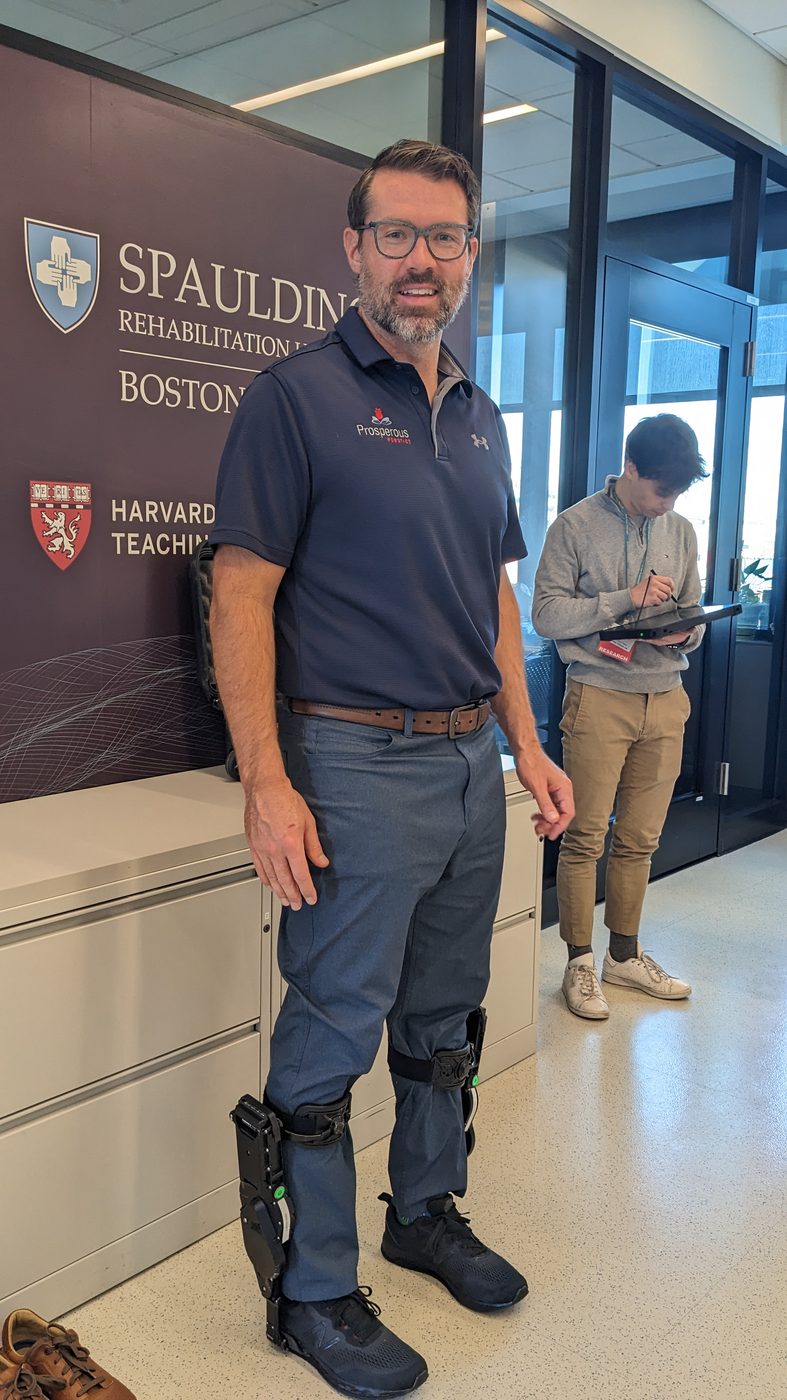
Michael Bankowski standing in front of a Spaulding Rehabilitation Hospital sign in Boston, wearing powered ankle modules strapped over his trousers and shoes. A researcher works at a tablet behind him.
Ankle modules at Spaulding Rehabilitation in Boston, a Harvard Medical School teaching affiliate. Being the person inside the device is not a requirement of this job. It has turned into a habit.

This page changes as we read.

Someone here reviews new work in these four areas on a regular cycle. When a paper changes what we think, both columns of the table get edited and the change is noted rather than quietly swapped in. When a paper contradicts something we have said, we would rather you saw that here than found it yourself.

If you work in this field and think a column is wrong, please tell us. That is a useful afternoon for everyone.

Evidence review last updated 22 September 2026. Nothing on this page is medical advice or a claim about any product.

English 日本語 한국어 简体中文 Polski